
By Dr. Michael Kamali, DBA, MBA, ChFC, CHE
Artificial intelligence is moving rapidly from experimentation into everyday business operations, but the most important question for business owners is not whether AI is impressive or whether competitors are talking about it. The real question is whether AI can produce measurable business value by reducing unnecessary costs, improving efficiency, strengthening customer or patient service, increasing productive capacity, and giving management better information for making decisions. When approached from that perspective, AI becomes less of a technology project and more of a management strategy.
Businesses throughout Southern California are facing many of the same pressures. A medical practice in Beverly Hills may struggle with documentation and administrative workload. A dental office in Pasadena may want to improve patient communication and treatment-plan acceptance. A law firm in Los Angeles may spend excessive professional time reviewing and organizing documents. A construction company in Long Beach may have difficulty tracking information across several projects. A growing company in Anaheim or Irvine may have more operational data than management can realistically analyze. Although these organizations operate in different industries, they share one challenge: valuable employee and management time is often consumed by repetitive work, fragmented information, unnecessary delays, and processes that were designed long before modern AI became available.
The opportunity is not simply to automate everything or reduce payroll. In many businesses, a better use of AI is to help existing employees perform higher-value work. If administrative tasks that once consumed three hours can be completed in forty-five minutes with appropriate AI assistance, management has recovered more than two hours of productive capacity. That time can be redirected toward patients, customers, projects, planning, quality improvement, employee development, or business growth. The economic benefit comes from improving how resources are used, not necessarily from removing people from the organization.
Table of Contents
ToggleAI Should Begin With a Business Problem, Not a Technology Purchase
One of the easiest mistakes for a business to make is deciding that it “needs AI” before identifying exactly what problem it is trying to solve. Businesses do not create value simply by subscribing to an AI application. They create value when technology improves a process that matters financially or operationally.
How AI Can Reduce Time Spent on Routine Business Tasks
| Business Activity | Traditional Process | AI-Assisted Process |
|---|---|---|
| Management Reporting | 8 hrs | 3 hrs |
| Document Processing | 7 hrs | 3 hrs |
| Data Analysis | 8 hrs | 3 hrs |
| Scheduling & Coordination | 5 hrs | 2 hrs |
| Administrative Follow-Up | 6 hrs | 3 hrs |
Illustrative business scenario. Actual time savings will vary depending on the organization, existing processes, technology, employee adoption, and implementation.
The table illustrates how AI can reduce the time employees and managers spend on repetitive administrative and analytical activities. The objective is not necessarily to reduce staffing. Instead, the recovered time can be redirected toward customers, patients, projects, management responsibilities, quality improvement, and other higher-value activities. For a business, the financial benefit can come from increasing productive capacity while reducing unnecessary work and administrative costs.
Management should therefore begin by asking where the organization is losing time, money, capacity, or service quality. Are employees repeatedly entering the same information? Are managers spending hours preparing routine reports? Are customers waiting too long for responses? Are appointments going unfilled? Is important business information scattered across several systems? Are errors creating rework? Does management discover cost overruns after they have already become serious? Are skilled professionals spending too much of their day performing administrative tasks that do not require their expertise?
These are business questions first. AI becomes relevant only after the problem has been clearly identified. For example, a business in Culver City may discover that project managers spend several hours each week compiling information from emails, spreadsheets, and project-management systems into a status report. The AI opportunity is not “implement AI.” The opportunity is to reduce the time required to gather, summarize, and organize the information while keeping the project manager responsible for interpretation and action. If that process saves several hours every week across multiple managers, the economic value can become significant over the course of a year.
Reducing Costs Does Not Have to Mean Reducing Employees
When AI and cost savings are discussed together, the conversation often turns immediately to workforce reduction. That is far too narrow. Labor is only one source of business cost, and many organizations have large amounts of avoidable expense embedded in inefficient processes. Costs can be reduced by lowering the amount of rework caused by errors, reducing overtime, improving scheduling, identifying unused capacity, accelerating information retrieval, shortening administrative processes, reducing missed appointments, improving inventory planning, detecting abnormal expenses earlier, and allowing managers to make faster decisions with better information.
Consider a growing service business in Santa Ana. Employees may spend substantial time searching for customer information, preparing repetitive correspondence, checking multiple systems, and answering similar questions throughout the day. An internal AI-assisted knowledge system could help staff retrieve approved information rapidly, prepare initial responses, and locate relevant documents without replacing the employee who ultimately interacts with the customer. If an employee can solve a customer issue in five minutes instead of fifteen, the company has increased capacity and improved the customer experience at the same time.
The same principle applies to a business in West Hollywood where employees are handling a high volume of customer inquiries. AI can help categorize requests, surface relevant information, summarize prior interactions, and prepare the employee for a faster and more informed response. The value comes from helping the employee perform the job more effectively rather than eliminating the relationship between the customer and the business. A strong AI strategy therefore asks a more useful question than, “How many jobs can this replace?” It asks, “How much unnecessary work can we remove from the jobs we already have?”
A Beverly Hills Dental Practice: Where AI Becomes Highly Practical
Dental practices provide one of the clearest examples of how AI can improve both clinical workflow and business performance without requiring a practice to become a technology company.
Where AI Can Create Value Across the Business
| Area of Business Value | Illustrative Share |
|---|---|
| Operational Efficiency | 25% |
| Administrative Productivity | 20% |
| Management Decision Support | 20% |
| Customer and Patient Service | 15% |
| Financial Analysis | 10% |
| Employee Capacity | 10% |
llustrative business-value model. The relative value of AI will vary considerably by industry, organization, existing technology, workflows, and management priorities.
AI can create value across multiple areas of a business rather than through a single application. For one organization, the greatest opportunity may be reducing administrative workload, while another may benefit more from operational improvements, financial analysis, or faster management decision-making. Medical and dental practices may place greater emphasis on patient service and administrative efficiency, while construction companies and other operating businesses may find greater value in project information, workflow management, cost analysis, and management reporting. The appropriate AI strategy should therefore reflect the specific economics and operational needs of each business.
Imagine a busy dental practice in Beverly Hills with several dentists, hygienists, assistants, front-office employees, and a practice manager. The practice has strong patient demand, but the staff experiences familiar operational problems. Dentists remain after hours completing notes. Hygienists spend time entering periodontal measurements. Front-office employees are repeatedly interrupted by calls involving appointments, office hours, insurance questions, and routine instructions. Patients sometimes struggle to understand what they are seeing on dental radiographs, making it more difficult to explain why a particular treatment may be necessary.
Current dental AI platforms are already addressing several of these problems. Denti.AI, for example, offers dental-specific AI tools for clinical documentation, charting, imaging analysis, patient communication, and reception functions. Its Scribe product can generate dental clinical notes from recorded patient encounters, understands dental terminology, supports dental note templates, and can assist with charting and treatment-planning information. From a management standpoint, this matters because documentation is not merely a clinical requirement. It consumes professional time. A dentist who spends less time preparing notes at the end of the day can devote more attention to patients, treatment planning, staff development, or simply reducing the workload that contributes to professional burnout.
The American Dental Association reported in July 2026 that 43.3% of responding dentists were already using AI for at least one task, while another 26.4% planned to do so. Current uses include imaging and diagnostics, insurance verification, business analytics, reception or front-desk activities, and explaining clinical findings to patients. The ADA data also show that dentists remain far more cautious about allowing AI to make treatment recommendations, which reinforces an important principle: AI is increasingly being adopted as a support tool rather than a substitute for professional judgment.
Better Visualization Can Improve Patient Understanding
One of the most valuable uses of AI in dentistry may have less to do with automation than with communication. A dentist can look at a radiograph and immediately recognize patterns because of years of education and clinical experience. The patient, however, may see little more than a gray image containing teeth and shadows. Even when the dentist explains the condition carefully, the patient may not fully understand what is being described.
AI-assisted dental imaging can make findings easier to visualize by identifying or highlighting areas that warrant professional attention. The dentist remains responsible for diagnosis and treatment decisions, but the visual presentation can make the conversation substantially easier for the patient to follow. That has a business implication as well as a clinical one. Patients are more likely to make confident decisions when they understand what is being recommended and why. Better visualization may therefore support treatment-plan acceptance because it reduces the information gap between the clinician and the patient. The dentist is not asking the patient to trust a computer; rather, the technology helps the dentist communicate professional findings in a format that may be easier for the patient to understand.
For a dental office in Beverly Hills, Pasadena, Arcadia, or Irvine, that improvement in communication can affect both patient experience and practice economics. A patient who clearly understands a condition may be more comfortable proceeding with necessary treatment, while the dentist can spend less time trying to translate complex radiographic information verbally. The strongest implementation is therefore human and technological at the same time: AI helps make the information clearer, while the dentist provides the judgment, explanation, and trust.
AI Can Extend the Capacity of a Dental Practice
Now consider another scenario involving a dental office in Irvine. The practice has strong demand, but incoming calls create constant interruption. Employees at the front desk are simultaneously checking patients in, answering insurance questions, scheduling appointments, handling payments, and responding to telephone calls. Calls arriving after hours may go unanswered, and some prospective patients may contact another practice rather than waiting for the office to reopen. A modern AI receptionist can provide another layer of capacity. Denti.AI’s current receptionist product, for example, can answer incoming calls, book, reschedule, or cancel appointments through supported practice-management systems, answer routine questions, provide office information, and route urgent or complex calls to staff. The company also offers multilingual capabilities.
The business case here is not that the practice should eliminate its receptionist. The front-office employee remains extremely important because patients often need empathy, explanation, judgment, and assistance that cannot be reduced to a routine transaction.
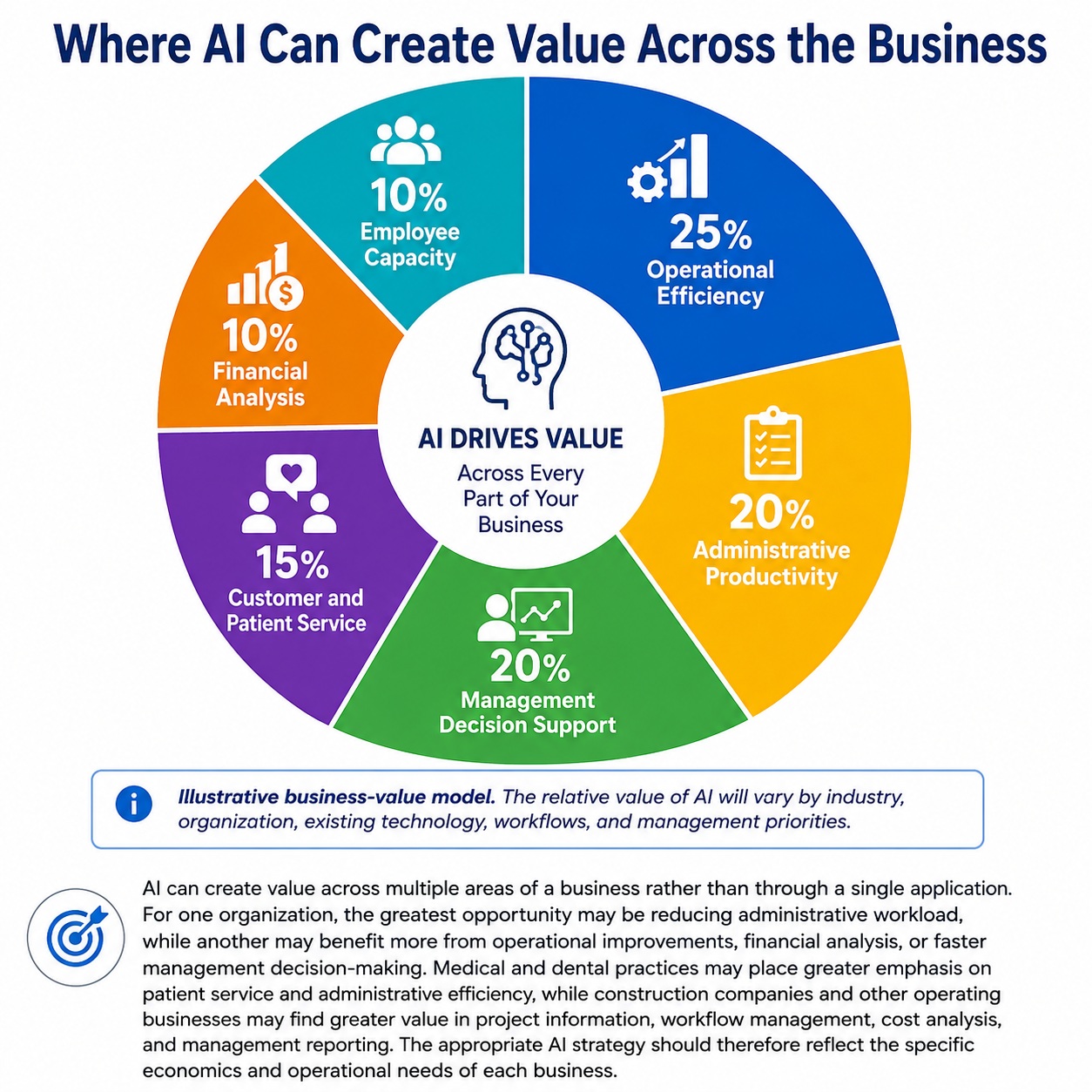
The better use case is overflow and after-hours coverage. If the AI system handles a routine appointment request at 8:00 p.m., the practice may capture a patient that otherwise would have gone elsewhere. If routine calls are handled while the front-office employee is helping a patient standing at the desk, both individuals may receive better service. The technology effectively increases service capacity without requiring the practice to remain physically staffed around the clock. That is an important distinction because revenue growth can be just as valuable as cost reduction. AI does not have to save money only by lowering expense; it can also help a business capture opportunities that previously went unanswered.
AI Can Help Address Administrative Burnout in Healthcare
The administrative burden in medical and dental practices is also a workforce issue. The ADA reported that approximately one-third of responding dentists considered themselves overworked, while interest in future AI adoption was especially strong for charting, note-taking, insurance-related activity, and other administrative tasks. That suggests an important management opportunity. If a practice can reduce the amount of repetitive documentation performed by doctors, dentists, hygienists, and staff, it may improve productivity without increasing workload.
Consider a medical office in Downey where physicians spend substantial time completing documentation after the final patient has left. An appropriately implemented AI documentation tool could help prepare structured notes from the clinical encounter for physician review. The physician remains responsible for reviewing and approving the record, but the technology may reduce the time spent manually producing it. The benefit is not merely faster paperwork. It may mean the physician can focus more fully on the patient during the visit, reduce work performed after normal office hours, and spend less professional time on clerical activity. In that context, AI becomes part of a retention and burnout-reduction strategy as well as an efficiency strategy.
Healthcare organizations, however, need to be particularly disciplined about privacy and security. The U.S. Department of Health and Human Services permits covered entities to use cloud services for electronic protected health information when HIPAA requirements are satisfied, including appropriate Business Associate Agreements and risk-management measures. Ease of use should therefore never be confused with absence of responsibility. A cloud-based system may be simple for employees to use, but management still needs to evaluate privacy, access controls, vendor relationships, data handling, security, and regulatory obligations before implementation.
AI in a Los Angeles Law Firm
A law firm in Los Angeles faces a very different set of business problems, but the underlying management logic is similar. Attorneys and staff may spend large amounts of time reviewing documents, comparing agreements, organizing correspondence, retrieving information from prior files, preparing initial drafts, and summarizing lengthy materials. Much of this work requires professional oversight, but not every minute spent processing information represents the highest-value use of an attorney’s time. AI can assist with document organization, summarization, information retrieval, preliminary comparison, and administrative workflow support. The attorney remains responsible for legal analysis, strategy, judgment, client advice, and the final work product.
Suppose an attorney previously spent three hours organizing and reviewing a large set of documents before beginning substantive analysis. If AI-assisted tools reduce the initial information-processing stage to one hour, the attorney has not become less important. The attorney has gained two additional hours for work that actually requires legal expertise. For management, the result may be improved turnaround time, better client responsiveness, and greater professional capacity without proportionally increasing overhead.
AI in a Long Beach Construction Company
A construction business in Long Beach provides another example. The company may be managing several jobs simultaneously, with information spread across estimates, change orders, schedules, vendor invoices, subcontractor communications, job-cost reports, and project notes. Management frequently has the information it needs somewhere in the organization but cannot locate, compare, or interpret it quickly enough. I-assisted analytics can help organize project information, identify unusual cost patterns, summarize project status, compare actual results against estimates, and bring exceptions to management’s attention.
Imagine that material costs on one project begin exceeding the estimate while schedule delays are also increasing. If the problem becomes visible only when the monthly report is completed, management may have already lost valuable time. An AI-assisted reporting process could help surface the pattern earlier, allowing management to investigate before the variance becomes more expensive. The AI does not determine whether the contractor should renegotiate with a supplier, modify scheduling, or change the project plan. Those are management decisions. The technology improves the speed and quality of the information upon which the decision is based.
That is one of the most important uses of AI for business: helping management identify the problem sooner.
Turning Business Data Into Management Intelligence
Many businesses already collect enormous amounts of information but use only a fraction of it effectively. A company in Anaheim may have years of sales information, customer activity, labor hours, expenses, purchasing records, service volume, and operational data. Management may nevertheless rely primarily on monthly financial statements and personal experience because analyzing everything else manually would take too much time.
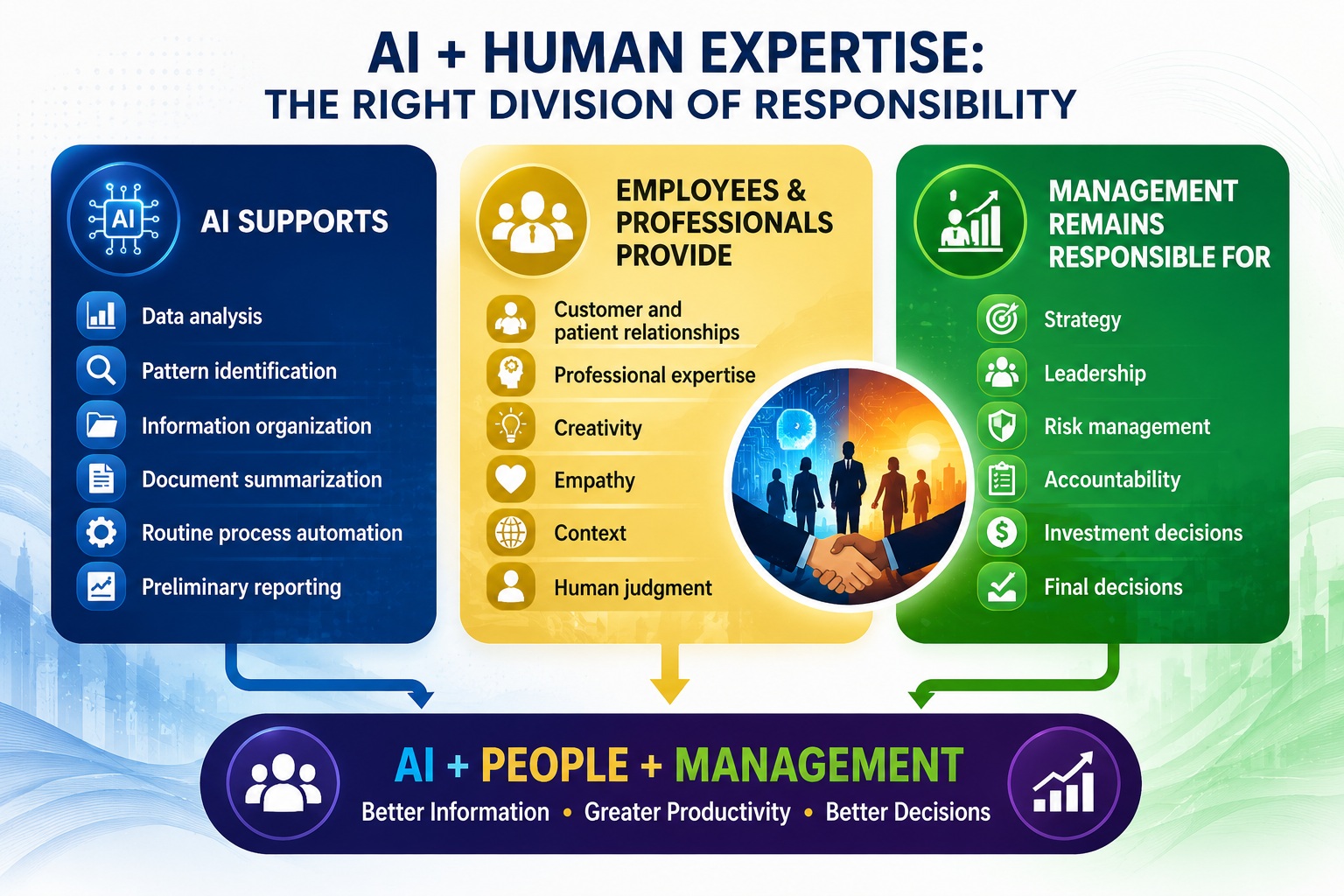
AI can create value across multiple areas of a business rather than through a single application. For one organization, the greatest opportunity may be reducing administrative workload, while another may benefit more from operational improvements, financial analysis, or faster management decision-making. Medical and dental practices may place greater emphasis on patient service and administrative efficiency, while construction companies and other businesses may find greater value in workflow management, cost analysis, operational information, and management reporting. The appropriate AI strategy should reflect the specific needs, economics, and priorities of each business.
AI and modern analytics can make that information more usable. Management can begin asking more sophisticated questions: Which services produce the strongest margins? Where are operating costs increasing faster than revenue? Which location is underperforming? Where is available capacity being wasted? Which customer or service patterns are changing? How would a 7% labor-cost increase affect profitability? What would happen to cash flow if revenue declined temporarily?
Can the organization support another location? Which operational KPI changed unexpectedly this month? The answers still need to be interpreted by management, but AI can dramatically reduce the amount of time required to assemble and analyze the underlying information. This is where AI becomes more than automation. It becomes decision support.
AI Can Improve Service Without Removing the Human Relationship
There are certain parts of a business that should become more human as technology improves, not less. Consider a professional-services company in Pasadena or Monrovia where employees regularly answer client questions, prepare documents, gather information, and manage multiple ongoing relationships. AI could help employees find approved information faster, prepare a first draft of correspondence, summarize prior interactions, or organize documents before a meeting. The employee still speaks with the client and remains responsible for the relationship.
The result may actually be better human service because less time is spent searching for information and more time is available for understanding the client’s problem. The same philosophy applies to healthcare. A dental assistant should not have to spend unnecessary time locating information that could be immediately available. A physician should not have to spend the evening formatting routine documentation. A practice manager should not have to manually assemble every KPI if the underlying data can be summarized more efficiently. Technology should reduce friction around the human relationship, not replace the relationship itself.
AI Opportunities Across Southern California Businesses
The applications will differ by organization. A medical practice in Beverly Hills may use AI primarily for documentation, administrative workflow, scheduling, and practice analytics. A dental office in Arcadia may concentrate on imaging support, periodontal charting, patient education, treatment-plan communication, and appointment management. A company in Pomona may focus on inventory, purchasing, workflow, and operating data. A business in Riverside or San Bernardino County may need better forecasting as it expands into a larger geographic market. A company in Culver City may use AI to improve project management and information retrieval.
A business in Ventura County may concentrate on management reporting and customer-service efficiency. A growing organization in San Diego County may use AI-assisted scenario analysis when considering another location, new employees, or a major capital investment. The technology is not the strategy. The strategy is identifying which business problem creates enough financial or operational value to justify the technology.
A Practical Framework for Evaluating AI
Before implementing any AI system, management should evaluate four factors. The first is business value. What problem is being solved, and how will improvement be measured? A project should have a baseline such as hours spent, cost per transaction, missed appointments, turnaround time, error rate, customer response time, or another meaningful KPI. The second is implementation difficulty. Management needs to understand whether the technology works with existing systems, what training will be required, how information will move between systems, and whether workflow changes are necessary. The third is risk. For a healthcare organization, that may include privacy and HIPAA considerations. For another business, it may involve confidential information, inaccurate output, intellectual property, cybersecurity, or inappropriate reliance on automated recommendations.
The fourth is human impact. Will the technology make employees more productive and customers better served, or will it create frustration, confusion, or deterioration in service quality? An AI project with high business value, manageable implementation difficulty, controlled risk, and positive employee impact is usually a much stronger candidate than one selected simply because the technology is new.
The Human Role Becomes More Important as AI Improves
As AI becomes more capable, some people assume human judgment will become less important. In many businesses, the opposite may be true. AI can process large amounts of information, identify patterns, prepare summaries, and perform repetitive tasks extremely quickly. What it cannot replace easily is accountability. Someone still has to decide whether the analysis makes sense. Someone must understand the customer. Someone must take responsibility for a patient’s treatment. Someone must decide whether a construction project should change course. Someone must determine whether a forecast is reasonable. Someone must understand the consequences of a business decision.
That is why AI should be designed around a human-in-the-loop model for important decisions. The technology can accelerate the work. The professional or manager remains accountable for the outcome. For dental practices, the current ADA data are particularly revealing: dentists are increasingly willing to use AI for efficiency, imaging, analytics, and administrative support, while very few are willing to rely on it for treatment recommendations. That is a sensible dividing line for many professions.
The Objective Should Be Better Jobs and Better Businesses
There is also a broader economic issue that deserves consideration. Employees are not merely costs to be minimized. They are also customers, patients, consumers, homeowners, parents, taxpayers, and participants in the communities in which businesses operate. If every organization evaluates AI exclusively by how aggressively it can eliminate employees, the long-term economic result becomes problematic. Businesses ultimately depend on people having income and purchasing power. At the company level, excessive workforce reduction can also destroy institutional knowledge, employee loyalty, customer relationships, and valuable experience.
A more sustainable approach is to use AI to improve the economics of the job itself. An employee who can complete routine work faster may be able to handle more customers. A practice manager with better analytics may identify problems earlier. A dentist who spends less time on documentation may have more time for patients. A project manager who receives better information may prevent costly delays. In other words, businesses should try to remove unnecessary work from jobs before removing people from the business.
Building an AI Strategy That Produces Measurable Results
A disciplined implementation process should begin with a small number of high-value opportunities rather than an organization-wide technology transformation. Management can start by mapping major workflows and identifying where employees spend disproportionate amounts of time. The current cost and performance of those activities should then be measured so the business has a baseline. Potential AI solutions can be evaluated against that baseline.
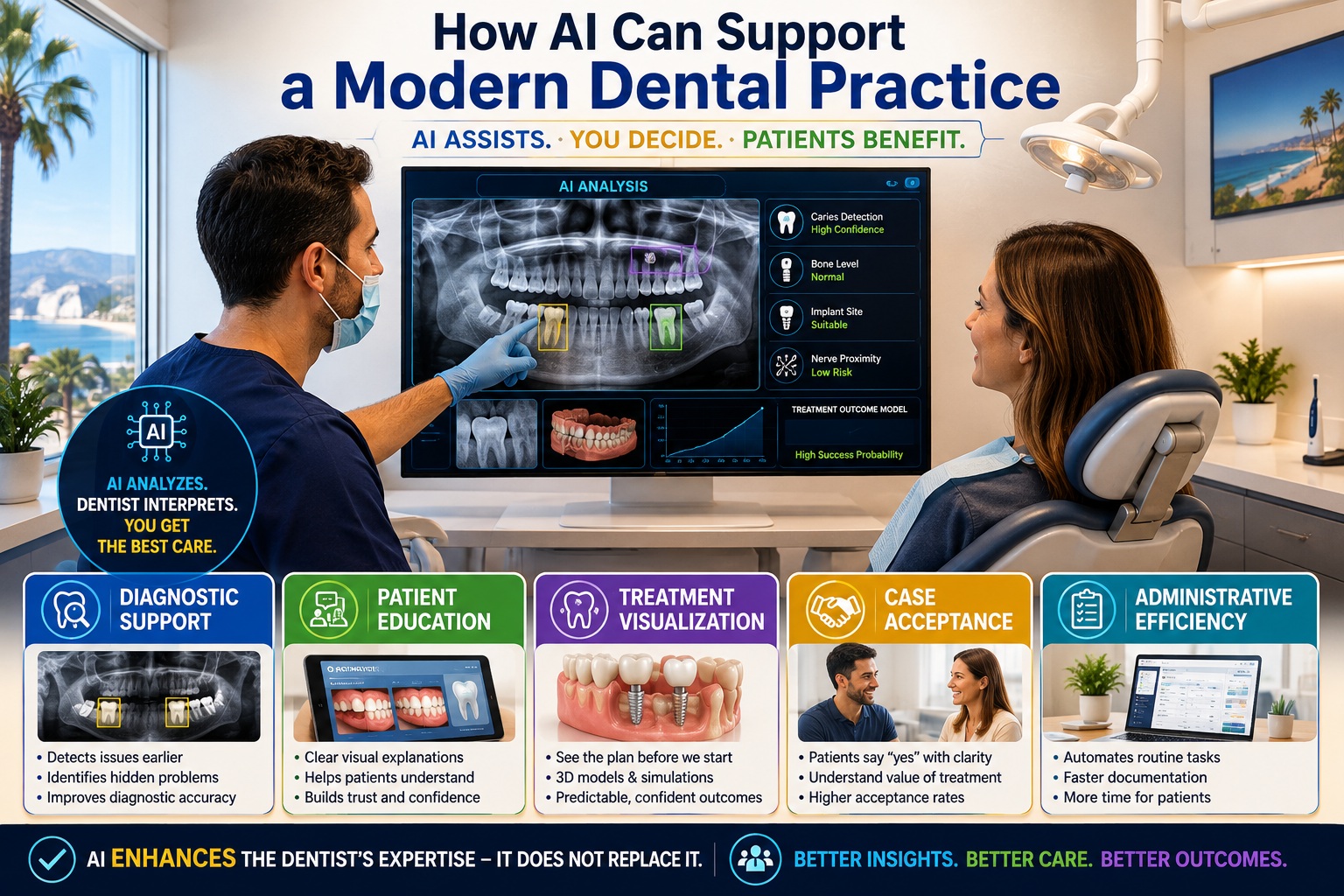
If an AI-assisted process is expected to reduce reporting time, management should measure reporting time before and after implementation. If the objective is to reduce missed appointments, track the appointment rate. If the objective is to improve case acceptance, measure it. If the objective is better forecasting, compare forecast accuracy. If the objective is to increase capacity, measure how many additional customers, patients, projects, or transactions the business can handle. This is how AI becomes a management discipline rather than a technology experiment. A successful pilot can then be expanded. An unsuccessful one can be stopped before management commits too much money, time, or organizational disruption.
AI Will Not Be the Competitive Advantage by Itself
Artificial intelligence is becoming easier to access. Many businesses will eventually have access to similar tools. The competitive advantage will therefore not come from simply owning AI software. It will come from knowing where to apply it, how to integrate it into the business, how to measure its financial return, how to protect customers and employees, and how to combine technology with sound management judgment. A dental practice that purchases AI but fails to redesign its workflow may accomplish very little. Another practice using the same technology may reduce documentation burden, improve patient communication, recover missed appointments, increase treatment understanding, and give employees more time for patients. The difference is not the software. The difference is management.
For businesses in Los Angeles, Beverly Hills, Long Beach, Pasadena, Culver City, Downey, Arcadia, Monrovia, Pomona, Irvine, Anaheim, Santa Ana, Riverside, San Bernardino, Ventura, San Diego, and throughout Southern California, AI represents a significant opportunity. But the strongest results will come from organizations that approach artificial intelligence as part of a broader business strategy rather than as a shortcut or a trend. The most useful question a business owner can ask is therefore not, “What can AI do?” It is:
“Where can AI create measurable value in my business?” Answering that question requires understanding the organization’s finances, operations, people, customers, technology, and long-term strategy. When those elements are considered together, AI can become a practical tool for reducing costs, improving efficiency, increasing capacity, strengthening service, and helping management make better decisions. That is the purpose of effective AI Strategy and Digital Transformation Consulting: not adopting artificial intelligence simply because it is available, but applying it where it can produce meaningful and measurable business results.
Author: Dr. Michael Kamali, DBA, MBA, ChFC, CHE
This version is much closer to what I’d publish. It reads as a continuous professional article rather than a sequence of short AI-generated statements. The next step should be to build the two or three visual elements directly around specific sections of this article, rather than adding generic charts just to break up the text.