
Medical and dental practices throughout California continue to face a challenging operating environment. Rising labor expenses, increasing supply costs, higher technology investments, and ongoing administrative demands are creating significant pressure on profitability.
For many practice owners, the traditional response has been to focus on increasing patient volume. While attracting new patients remains important, volume alone is no longer enough to protect margins. Practices that continue to rely solely on revenue growth often find that higher patient volumes add complexity, place greater demands on staff, and increase operational strain.
As a result, practices may see more appointments, higher revenues, and greater activity while experiencing declining profitability. This pattern is becoming increasingly common across independent medical and dental practices. The underlying issue is not always insufficient demand. In many cases, the problem is operational inefficiency. The most successful practices recognize that long-term profitability depends not only on clinical excellence but also on operational discipline.
Understanding Margin Compression in Healthcare Practices
Margin compression occurs when operating expenses increase faster than revenue. Several factors are contributing to this challenge.
Labor costs continue to rise as practices compete for experienced clinical and administrative personnel. Benefits, expenses, payroll taxes, and employee retention initiatives further increase staffing costs. Supply expenses have increased significantly due to inflationary pressures, supply chain disruptions, and higher vendor pricing.
Technology investments have become essential for maintaining competitiveness. Electronic health records, practice management systems, cybersecurity requirements, and patient communication platforms require ongoing investment. At the same time, reimbursement rates often fail to keep pace with increasing expenses. This combination creates a difficult environment for practice owners. Increasing prices may not always be feasible. Hiring additional staff may not solve underlying workflow issues. Expanding patient volume without improving operational efficiency frequently creates additional pressure on existing resources.
The result is a gradual decline in profitability despite strong demand.
Table: Common Cost Pressures and Operational Responses for Medical and Dental Practices
| Cost Pressure Impact | t on Practices Common Reaction Recommended | ed Operational Response | |
|---|---|---|---|
| Rising clinical and administrative wages | Higher payroll expenses and reduced margins | Delay hiring or reduce staff | Improve scheduling efficiency and standardize workflows |
| Increasing supply and equipment costs | Higher operating expenses | Reduce inventory purchases | Strengthen vendor management and purchasing controls |
| Administrative burden | Increased overtime and staff frustration | Add more administrative personnel | Streamline documentation and automate routine tasks |
| Patient no-shows and cancellations | Lost provider capacity and lower revenue | Increase marketing spend | Implement scheduling protocols and patient reminders |
| Delayed claims and collections | Reduced cash flow and higher accounts receivable | Focus solely on collections | Improve revenue cycle processes and billing accuracy |
| Technology investments | Higher short-term expenses | Delay system upgrades | Evaluate return on investment and optimize utilization |
| Regulatory and compliance requirements | Greater operational complexity | Add manual review steps | Standardize procedures and improve staff training |
Key takeaway: Practices cannot control inflation or labor markets, but they can improve operational performance.
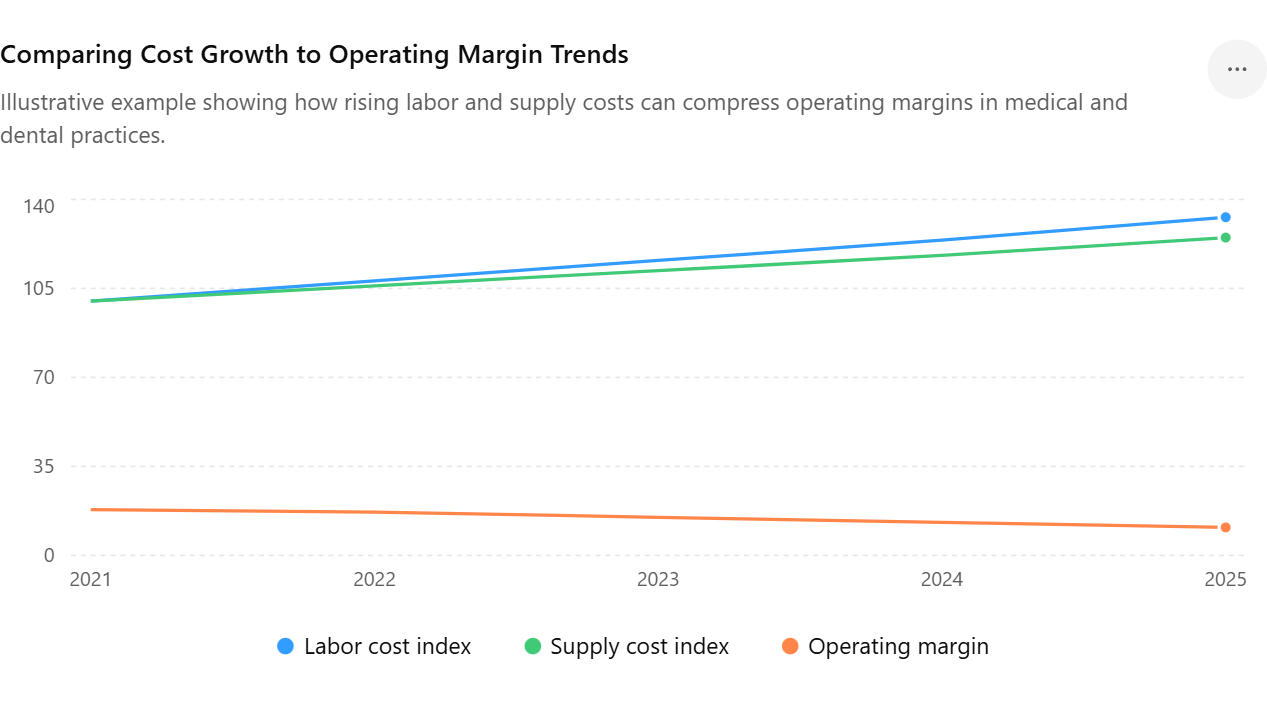
Graphic 1: Rising Costs Versus Declining Margins
A line chart showing:
-
- Labor Cost Index: 100 → 135
-
- Supply Cost Index: 100 → 125
-
- Average Practice Operating Margin: 18% → 11%
Title:
Rising Costs and Margin Compression in Healthcare Practices
This graphic visually reinforces the article’s central problem.
Why More Patients Do Not Always Increase Profitability
Many practice owners assume that declining margins can be solved by scheduling more appointments. While higher patient volumes can increase revenue, they can also expose operational weaknesses. As patient demand grows, practices often experience longer wait times, increased scheduling complexity, higher administrative workloads, and greater communication challenges. Without efficient workflows, additional volume may create more rework, more errors, and greater staff burnout.
For example, a practice that struggles with appointment-scheduling inefficiencies may experience increased no-show rates and underutilized provider capacity. Similarly, delays in documentation, billing, or claims processing can negatively affect cash flow even when patient demand remains strong. Growth without operational discipline often increases complexity faster than profitability increases.
Common Sources of Operational Inefficiency
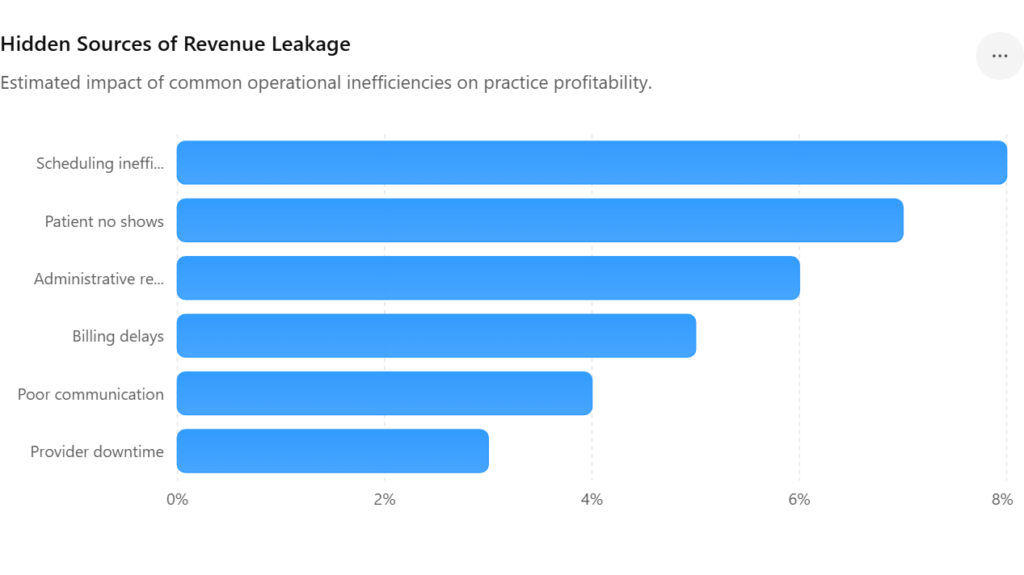
Operational inefficiencies often develop gradually and become normalized over time. Practice leaders may not recognize the financial impact because these costs rarely appear as a separate line item on financial statements.
Common areas of inefficiency include:
-
- Ineffective appointment scheduling
-
- High no-show and cancellation rates
-
- Excessive administrative workloads
-
- Unclear staff responsibilities
-
- Communication breakdowns between departments
-
- Delays in claims submission and collections
-
- Manual data entry and duplicate processes
-
- Inconsistent inventory management
-
- Limited performance reporting
-
- Insufficient workflow standardization
Individually, each issue may appear manageable. Collectively, they create substantial financial pressure. The cumulative effect often includes higher labor costs, increased employee turnover, reduced patient satisfaction, and declining profitability.
Labor Costs Require Productivity Improvements
Labor expenses are typically among the highest costs for medical and dental practices. When labor costs rise, many organizations respond by delaying hiring decisions or reducing staffing levels. While these actions may create short-term savings, they rarely address underlying operational challenges.
The more effective approach is to improve labor productivity.
Productivity improvement does not mean asking employees to work harder. It means designing workflows that enable teams to work more efficiently.
Examples include:
-
- Reducing repetitive administrative tasks
-
- Clarifying roles and responsibilities
-
- Improving provider scheduling
-
- Standardizing patient intake processes
-
- Eliminating duplicate documentation
-
- Streamlining communication procedures
When practices improve workflow efficiency, they often increase capacity without increasing headcount. This approach supports both employee satisfaction and financial performance.
Operational Visibility Drives Better Decisions
Many practices lack the performance data necessary to identify operational problems. Without meaningful metrics, leaders often rely on assumptions rather than evidence. Key performance indicators provide visibility into operational effectiveness.
Examples include:
| Operational Metric: Why | y It Matters |
|---|
| Provider utilization rate | Measures clinical capacity and scheduling effectiveness |
| Appointment no-show rate | Identifies lost revenue opportunities |
| Days in accounts receivable | Evaluates billing performance and cash flow |
| Patient wait time | Reflects workflow efficiency and patient experience |
| Staff turnover rate | Indicates organizational stability |
| Revenue per provider | Measures productivity and financial performance |
Regular performance reviews help leaders identify trends before they become significant problems.
Data-driven decision-making enables practices to allocate resources more effectively and prioritize improvement initiatives.
Technology Is Only Part of the Solution
Many practices respond to operational challenges by investing in new technology. Technology can improve efficiency, but software alone rarely solves workflow problems. Automating inefficient processes often increases complexity rather than reducing it. Before implementing new systems, practice leaders should evaluate existing workflows and identify root causes.
Questions to consider include:
-
- Are current processes clearly documented?
-
- Do employees understand their responsibilities?
-
- Are tasks unnecessarily duplicated?
-
- Are communication channels effective?
-
- Can performance be measured consistently?
Technology should support well-designed processes.
It should not replace operational discipline.
Practical Strategies for Improving Profitability
Practices seeking to protect margins should focus on operational improvement initiatives that create measurable value.
Effective strategies include:
Optimize Scheduling Processes
Review appointment templates, provider utilization, and cancellation patterns.
Improved scheduling practices can increase capacity without adding staff.
Standardize Workflows
Document critical processes and establish consistent procedures across the organization. Standardization reduces errors and improves efficiency.
Improve Revenue Cycle Performance
Evaluate billing processes, claims management, and collection procedures. Reducing delays in accounts receivable improves cash flow and profitability.
Reduce Administrative Burden
Identify repetitive tasks that can be simplified or automated. Administrative efficiency allows staff to focus on higher-value activities.
Strengthen Performance Reporting
Develop dashboards that provide visibility into operational and financial metrics. Timely information supports better decision-making.
Improve Cross-Functional Communication
Clear communication reduces delays, minimizes errors, and improves coordination between clinical and administrative teams.
The Connection Between Employee Experience and Profitability
Operational inefficiencies affect more than financial performance. They also influence employee satisfaction and retention. Employees who work in poorly designed systems often experience frustration, stress, and burnout. High turnover increases recruiting costs, onboarding expenses, and productivity losses. By improving workflows and clarifying expectations, practices create a more supportive work environment.
Strong operational systems allow employees to focus on patient care rather than administrative obstacles. Improved employee experiences frequently lead to better patient experiences. Satisfied employees are more likely to deliver consistent service, communicate effectively, and contribute to positive outcomes.
Building Long-Term Operational Resilience
Economic conditions will continue to evolve. Labor costs, supply expenses, and regulatory requirements will likely remain challenging for the foreseeable future. Practices cannot control external market conditions. They can control how effectively they operate.
Organizations that invest in operational discipline are better positioned to adapt to changing environments. They are better equipped to protect margins, support employees, and maintain high levels of patient satisfaction. Long-term success depends on building systems that support sustainable performance. Operational resilience is created through intentional leadership, consistent processes, meaningful metrics, and continuous improvement.
Conclusion
Medical and dental practices are facing unprecedented pressure from rising costs and shrinking margins. Attempting to solve these challenges through increased patient volume alone often creates additional complexity. The most effective response is not simply cost reduction. It is an operational improvement. Practices that strengthen workflows, improve communication, increase visibility into performance metrics, and optimize resource utilization can protect profitability without compromising patient care. Operational efficiency is no longer a competitive advantage.
It is a business necessity. Leaders who invest in operational excellence today will be better prepared to navigate future challenges and build practices that are financially sustainable, operationally resilient, and ready for long-term growth.
How California Business Consulting Can Help
California Business Consulting helps medical and dental practices strengthen business performance through strategic planning, operational improvement, financial analysis, workflow optimization, KPI reporting, practice startups, acquisitions, expansions, SBA and commercial loan business plans, financial forecasting, organizational efficiency, and long-term growth strategies. Whether you are opening a new practice, purchasing an existing office, expanding your operations, or improving profitability, we provide practical, data-driven solutions that help you make informed decisions and build sustainable success. To learn more or schedule a confidential consultation, contact Dr. Michael Kamali, DBA, MBA, ChFC, at (310) 541-1000 or visit https://calbizconsulting.com.
:::
- Business Planning Services (
/services/business-planning-services/) - SBA Planning Support (
/services/sba-planning-support/) - Healthcare Consulting (
/services/healthcare-consulting/) - Dental Practice Consulting (
/services/dental-practice-consulting/) - Financial Analysis & Decision Support (
/services/financial-analysis-decision-support/)