
Every medical and dental practice strives to deliver exceptional patient care.
Yet many practices experience declining patient satisfaction, increasing staff frustration, and stagnant profitability despite maintaining strong clinical outcomes.
The cause is often not clinical quality.
It is workflow inefficiency.
Workflow bottlenecks develop gradually as practices grow. Over time, seemingly minor inefficiencies create delays, communication gaps, increased administrative burden, and inconsistent patient experiences.
Many practice owners respond by adding more staff, extending office hours, or increasing patient volume.
However, if the underlying workflow is inefficient, growth can amplify operational problems rather than solve them.
Sustainable practice growth requires more than demand. It requires operational discipline, process improvement, and performance visibility.
What Is a Workflow Bottleneck?
A workflow bottleneck occurs when one process, department, or resource limits the efficient flow of work throughout the organization.
In healthcare environments, bottlenecks can occur at any stage of the patient journey.
Common examples include:
- Appointment scheduling delays
- Lengthy patient check-in procedures
- Insurance verification issues
- Inefficient provider scheduling
- Delayed documentation
- Billing and coding errors
- Communication breakdowns between clinical and administrative teams
- Delayed patient follow-up
When one step slows down, the entire process is affected.
A delay at the front desk can impact the provider’s schedule. Delayed documentation can affect billing. Poor communication can create frustration for both staff and patients.
Workflow optimization is not simply an administrative exercise. It directly influences patient satisfaction, operational efficiency, and financial performance.
The Hidden Cost of Workflow Inefficiencies
Many practice owners underestimate the financial impact of workflow inefficiencies because the costs are often indirect.
Workflow problems rarely appear as a single expense item.
Instead, they appear through declining performance indicators.
Common consequences include:
- Increased patient wait times
- Higher no-show rates
- Lower provider utilization
- Reduced appointment capacity
- Increased staff overtime
- Higher employee turnover
- Delayed collections
- Lower patient retention
- Reduced referral activity
For example, if insurance verification is not completed before appointments, front-office staff may spend valuable time resolving eligibility issues during patient visits.
That delay affects check-in, provider schedules, patient satisfaction, and collections.
One small process failure often creates multiple operational consequences.
Illustrative Results After Workflow Improvement
| Practice Performance Area | Before Improvement | After Improvement |
|---|---|---|
| Average Patient Wait Time | 28 minutes | 14 minutes |
| No-Show Rate | 15% | 9% |
| Provider Utilization | 70% | 84% |
| Staff Overtime | 20 hours/week | 8 hours/week |
| Claims Denial Rate | 11% | 5% |
| Patient Satisfaction Score | 78% | 91% |
These examples demonstrate an important principle:
When practices improve workflows, the benefits extend beyond operational efficiency. Process improvements often enhance patient experience, staff satisfaction, provider productivity, and financial performance simultaneously.
Scenario: A Growing Medical Practice
Consider a multi-provider medical office that experiences a 30 percent increase in patient volume over two years.
Appointment schedules remain full, revenue continues to increase, and leadership hires additional staff to support growth.
Initially, the expansion appears successful.
However, operational performance begins to decline.
Patients experience longer wait times. Staff members report feeling overwhelmed. Providers spend more time resolving administrative issues instead of focusing on patient care.
Patient complaints increase.
Despite higher revenue, profitability remains stagnant.
Leadership initially assumes the solution is to hire additional employees.
However, after conducting a workflow analysis, the practice discovers that staffing is not the primary issue.
The practice identifies several operational bottlenecks:
- Duplicate patient data entry
- Inefficient scheduling templates
- Delayed insurance verification
- Unclear staff responsibilities
- Delayed clinical documentation
- Limited performance reporting
By redesigning workflows, clarifying responsibilities, and implementing key performance indicators, the practice improves operational efficiency and restores profitability.
The lesson is simple:
Growth without process improvement often creates operational instability.
Using Data to Improve Operational Performance
Healthcare leaders cannot improve what they do not measure.
Data-driven decision-making helps practices move beyond assumptions and focus on measurable outcomes.
Important operational metrics include:
- Average patient wait time
- Appointment utilization rate
- Provider productivity
- No-show rate
- Days in accounts receivable
- Claims denial rate
- Patient retention rate
- Staff turnover rate
- Patient satisfaction score
Tracking these metrics consistently helps leaders identify trends before they become significant operational problems.
An increase in no-show rates may indicate scheduling or communication issues.
A decline in provider utilization may suggest inefficient appointment templates.
A rising claims denial rate may indicate documentation or insurance verification problems.
Performance analytics create accountability and help connect operational activity to business outcomes.
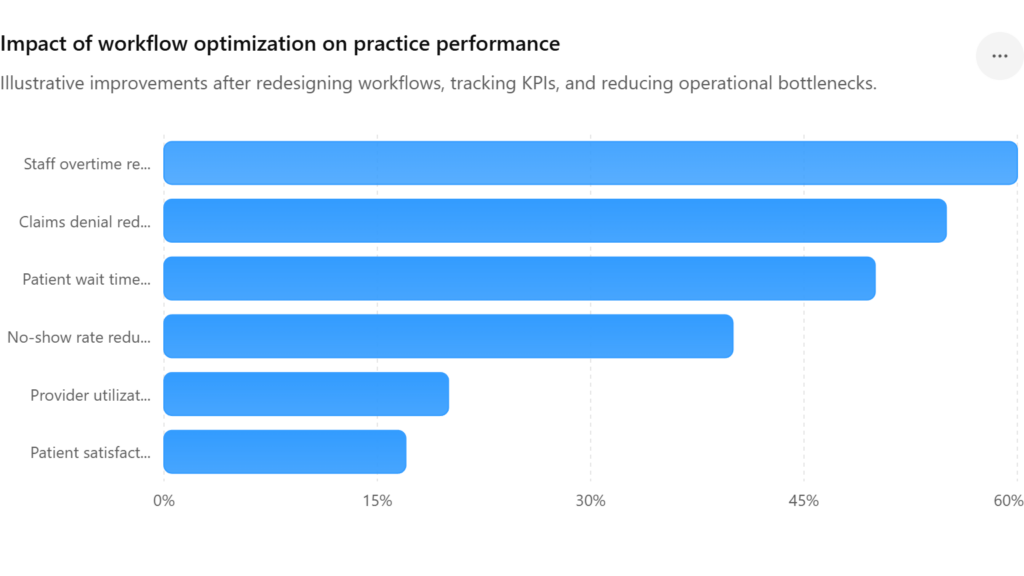
Illustrative Impact of Workflow Optimization
| Operational Improvement | Performance Gain |
| Staff Overtime Reduction | 60% |
| Claims Denial Reduction | 55% |
| Patient Wait Time Reduction | 50% |
| No-Show Rate Reduction | 40% |
| Provider Utilization Increase | 20% |
| Patient Satisfaction Increase | 17% |
Signs Your Practice May Have Workflow Bottlenecks
Healthcare leaders should pay close attention to the following warning signs:
- Frequent schedule disruptions
- Rising patient complaints
- Increasing staff turnover
- Excessive overtime
- Delayed billing cycles
- Persistent communication problems
- High no-show rates
- Declining provider productivity
- Inconsistent patient follow-up
- Repeated administrative errors
These indicators suggest that existing workflows may no longer support current patient demand.
Ignoring these signals often results in larger operational challenges later.
How to Identify Workflow Bottlenecks
Effective process improvement begins with understanding how work actually moves through the organization.
Practice leaders should map the patient journey from first contact through final payment.
This includes:
- Initial inquiry
- Appointment scheduling
- Patient intake
- Insurance verification
- Clinical visit
- Documentation
- Billing and claims submission
- Payment collection
- Follow-up communication
At each stage, leaders should ask:
- Where do delays occur?
- Which tasks require duplicate work?
- Where do communication gaps exist?
- Which activities create rework?
- Which processes depend too heavily on individual employees?
Staff input is essential.
The people performing the work often know exactly where the process breaks down.
Their insight can help leadership identify problems that may not be visible from financial reports alone.
Building a Culture of Continuous Improvement
Process improvement is not a one-time initiative.
High-performing healthcare organizations continuously evaluate and refine their operations.
A culture of continuous improvement includes:
- Regular workflow reviews
- Clear accountability
- Staff feedback
- Performance measurement
- Cross-functional communication
- Ongoing training
- Leadership follow-through
The goal is not to criticize employees.
The goal is to improve the system in which employees work.
When workflows are well designed, staff members perform more effectively, patients receive better service, and leaders gain greater operational control.
Key Takeaway
Most healthcare practices do not have a demand problem.
They have a workflow problem.
Increasing patient volume may boost revenue, but if operational systems are weak, growth can increase stress, reduce profitability, and undermine patient satisfaction.
Improving operational efficiency often produces greater long-term results than simply adding more patients.
Final Thoughts
Exceptional patient care depends on effective operations.
Workflow bottlenecks may seem minor in isolation, but over time they reduce efficiency, increase costs, and weaken patient experience.
Medical and dental practices that invest in workflow optimization, performance analytics, and process improvement are better positioned to improve profitability and support sustainable growth.
If your practice is experiencing operational challenges, now may be the right time to evaluate your workflows and identify opportunities for improvement.
How California Business Consulting Can Help
California Business Consulting helps medical and dental practices strengthen business performance through strategic planning, operational improvement, financial analysis, workflow optimization, KPI reporting, practice startups, acquisitions, expansions, SBA and commercial loan business plans, financial forecasting, organizational efficiency, and long-term growth strategies. Whether you are opening a new practice, purchasing an existing office, expanding your operations, or improving profitability, we provide practical, data-driven solutions that help you make informed decisions and build sustainable success. To learn more or schedule a confidential consultation, contact Dr. Michael Kamali, DBA, MBA, ChFC, at (310) 541-1000 or visit https://calbizconsulting.com.
To learn more about improving your practice’s efficiency and long-term performance, contact California Business Consulting at 310-541-1000.
- Business Planning Services (
/services/business-planning-services/) - SBA Planning Support (
/services/sba-planning-support/) - Healthcare Consulting (
/services/healthcare-consulting/) - Dental Practice Consulting (
/services/dental-practice-consulting/) - Financial Analysis & Decision Support (
/services/financial-analysis-decision-support/)