
Growth is often viewed as the ultimate measure of success for medical and dental practices.
More patients, expanded services, additional providers, and increasing revenue are all positive indicators of a healthy organization. However, growth introduces a level of operational complexity that many healthcare leaders underestimate.
As patient volume increases, processes that once worked effectively often begin to fail. Scheduling becomes more difficult. Communication gaps emerge between clinical and administrative teams. Billing delays increase. Staff members become overwhelmed, and patient experiences become inconsistent.
Ironically, many healthcare organizations discover that as revenue grows, operational control declines.
The problem is rarely a lack of demand.
The problem is that operational infrastructure has not evolved at the same pace as growth.
Healthcare leaders who recognize this challenge early can create sustainable systems that support long-term success—those who do not often find themselves trapped in a cycle of reactive management.
Growth Creates Complexity
During the early stages of a practice, workflows are often informal.
Providers communicate directly with front-office staff. Leadership maintains visibility into daily operations. Decisions are made quickly, and problems are resolved in real time.
As practices grow, these informal systems become increasingly difficult to maintain.
Adding providers, locations, technologies, and administrative staff increases operational complexity across every aspect of the organization.
Common warning signs include:
- Longer patient wait times
- Scheduling bottlenecks
- Increased staff overtime
- Delays in billing and collections
- Higher no-show rates
- Communication breakdowns
- Inconsistent patient experiences
- Reduced provider productivity
These challenges rarely appear all at once.
Instead, they develop gradually as operational demands outpace existing processes.
Without strategic planning and process improvement, growth can unintentionally create inefficiencies that reduce profitability, increase employee turnover, and negatively affect patient satisfaction.
Scenario: A Growing Dental Practice
Consider a three-provider dental practice that experiences a 25% increase in patient volume over two years.
At first, the growth appears successful. Revenue increases steadily, appointment schedules remain full, and the practice hires additional administrative staff to keep up with demand.
However, operational performance begins to decline.
Front-office teams struggle to manage scheduling changes. Patient wait times increase. Billing delays become more frequent. Providers spend more time resolving administrative issues instead of focusing on patient care.
Despite growing revenue, profitability remains stagnant.
The practice owners eventually realize that the issue is not demand.
The issue is that workflows designed for a smaller practice were never redesigned to support a larger organization.
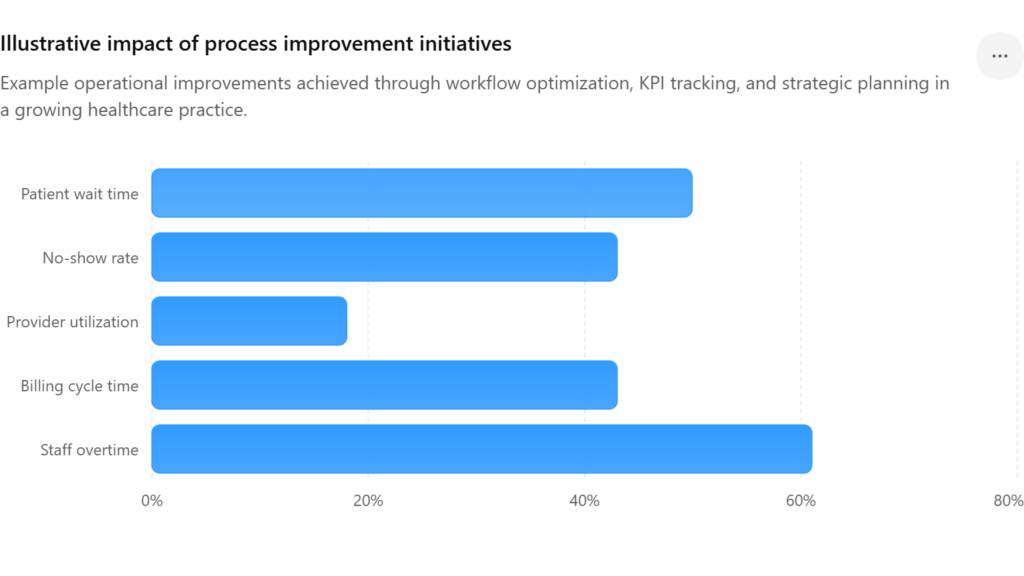
By implementing standardized processes, tracking key performance indicators, and conducting regular operational reviews, the practice improves scheduling efficiency, reduces overtime costs, and increases provider utilization.
Growth becomes sustainable because operational systems finally support organizational goals.
| Performance Indicator | Before Improvement | After Improvement |
|---|---|---|
| Patient Wait Time | 24 minutes | 12 minutes |
| No-Show Rate | 14% | 8% |
| Provider Utilization | 72% | 85% |
| Billing Cycle Time | 21 days | 12 days |
| Staff Overtime | 18 hours/week | 7 hours/week |
The Role of Strategic Planning in Healthcare Practice Management
Many healthcare organizations view strategic planning as an annual budgeting exercise or a discussion about future growth opportunities.
In reality, effective strategic planning connects long-term objectives with day-to-day operations.
For medical and dental practices, strategic planning answers several critical questions:
- What are our growth objectives over the next one to three years?
- Which operational constraints could limit performance?
- What investments are required to support growth?
- How will we measure success?
- Which processes need to be redesigned?
Without a clear strategy, practices often become reactive.
Leaders spend their time responding to staffing shortages, patient complaints, scheduling issues, and administrative bottlenecks instead of proactively improving performance.
Strategic planning creates alignment between organizational goals, operational capabilities, and available resources.
It transforms growth from a reactive process into an intentional one.
Process Improvement and Workflow Optimization
Operational excellence does not happen by accident.
High-performing healthcare organizations continuously evaluate and improve their workflows.
Process improvement begins with understanding how work actually gets done.
Every patient interaction involves a series of interconnected steps:
- Appointment scheduling
- Patient registration
- Insurance verification
- Clinical care delivery
- Documentation
- Billing and collections
- Follow-up communication
When even one step becomes inefficient, the entire process can be affected.
For example, incomplete patient registration may delay insurance verification, increasing claim denials and slowing cash flow.
Similarly, inefficient scheduling practices can reduce provider utilization while increasing patient wait times.
Workflow optimization helps practices:
- Eliminate redundant tasks
- Reduce administrative burden
- Improve communication
- Increase provider productivity
- Enhance patient experiences
- Strengthen financial performance
Successful process improvement initiatives typically focus on incremental changes rather than large-scale disruption.
Small operational improvements implemented consistently often generate significant long-term results.
Why Performance Analytics Matter
Healthcare leaders cannot improve what they do not measure.
Data-driven decision-making provides visibility into operational performance and helps organizations identify opportunities for improvement.
Key performance indicators allow leaders to move beyond assumptions and focus on measurable outcomes.
Common healthcare practice metrics include:
- Patient wait times
- Appointment utilization rates
- No-show rates
- Provider productivity
- Patient retention rates
- Days in accounts receivable
- Revenue per patient visit
- Staff turnover rates
Monitoring these metrics regularly helps practices identify emerging trends before they become significant problems.
For example, an increase in patient no-show rates may indicate scheduling challenges or communication issues.
A decline in provider utilization may suggest workflow inefficiencies or staffing imbalances.
Performance analytics create accountability, improve decision-making, and support strategic planning initiatives.
Practices that leverage operational data effectively are better equipped to adapt to changing market conditions and patient expectations.
Questions Every Practice Owner Should Ask
Healthcare leaders should regularly evaluate whether their operational systems can support continued growth.
Consider the following questions:
- Which operational bottlenecks create the greatest inefficiencies?
- Are we measuring the right performance indicators?
- Where do communication gaps affect patient care?
- Do our workflows support our current patient volume?
- Which processes create unnecessary delays or rework?
- Are our staffing models aligned with patient demand?
The answers to these questions often reveal opportunities for meaningful improvement.
Building Operational Infrastructure for Sustainable Growth
Growth should strengthen a healthcare organization—not create instability.
Sustainable growth requires intentional investment in operational infrastructure.
That includes:
- Strategic business planning
- Workflow optimization
- Performance measurement
- Leadership alignment
- Process improvement
- Cross-functional communication
Healthcare practices that proactively invest in operational excellence are better positioned to improve patient experiences, increase profitability, and achieve long-term success.
Final Thoughts
Medical and dental practices operate in increasingly complex environments.
Rising costs, staffing challenges, evolving reimbursement models, and growing patient expectations require leaders to think beyond day-to-day operations.
Clinical excellence remains essential, but it is no longer sufficient on its own.
Long-term success depends on the ability to combine exceptional patient care with operational discipline.
Strategic planning, process improvement, and performance analytics provide the foundation for sustainable growth.
Practices that invest in operational infrastructure today will be better prepared to navigate future challenges while delivering outstanding patient experiences.
Dr. Michael Kamali, DBA, MBA, ChFC, helps healthcare organizations, dental practices, and growing businesses improve performance through strategic planning, operational optimization, financial analysis, and process improvement.
If your practice is experiencing growth without operational stability, now may be the right time to evaluate your workflows, performance metrics, and long-term strategy.
Ready to Improve Your Practice’s Performance?
Sustainable growth requires more than increasing patient volume. It requires strategic planning, operational discipline, efficient workflows, and clear performance metrics.
If your medical or dental practice is experiencing operational challenges, workflow bottlenecks, communication gaps, or difficulty scaling effectively, California Business Consulting can help.
Dr. Michael Kamali, DBA, MBA, ChFC, works with healthcare organizations, medical offices, and dental practices to improve operational efficiency, strengthen decision-making, and build the infrastructure needed for long-term success.
To discuss your practice’s goals and operational challenges, contact:
Dr. Michael Kamali, DBA, MBA, ChFC
California Business Consulting
📞 310-541-1000
Whether you are planning for growth, improving workflows, or seeking greater operational visibility, the right strategy can help transform complexity into sustainable performance.
- Business Planning Services (
/services/business-planning-services/) - SBA Planning Support (
/services/sba-planning-support/) - Healthcare Consulting (
/services/healthcare-consulting/) - Dental Practice Consulting (
/services/dental-practice-consulting/) - Financial Analysis & Decision Support (
/services/financial-analysis-decision-support/)